Author Name: Tuskerply
Choosing the right plywood is one of the most important decisions when designing furniture, renovating a home, or planning commercial interiors. However, with so many plywood brands, grades, thicknesses and price ranges available in the market, identifying good quality plywood can be challenging.
Imagine investing in a beautiful modular kitchen, only to discover swollen cabinet edges, loose hinges and damaged shelves after a few months. Your furniture may look premium initially, but its long-term durability depends significantly on the quality of the plywood used underneath.
A small saving while purchasing plywood can eventually lead to expensive repairs and replacements.
This practical plywood buying guide will help you understand how to identify the best quality plywood, choose the right grade and make a confident purchasing decision that delivers long-term value.
1. Understand What Makes Good Quality Plywood
Plywood is an engineered wood product manufactured by bonding multiple thin layers of wood veneers together. These layers are generally arranged with alternating grain directions to improve strength and dimensional stability.
However, not all plywood sheets are manufactured using the same materials or production processes.
The quality of plywood depends on several important factors:
- Quality of the internal wood veneers
- Strength of adhesive bonding
- Uniformity of the core layers
- Manufacturing and pressing process
- Thickness consistency
- Moisture resistance
- Resistance to termites, borers and fungal attacks, where treated
Poor-quality plywood may contain internal gaps, uneven layers and weak bonding. These issues can affect furniture strength even when the external surface appears attractive.
Pro Tip: Never judge plywood quality solely by its appearance. The internal construction is just as important as the external finish.
2. Understand Different Plywood Grades Before Buying
Selecting the correct plywood grade according to its application can significantly improve furniture performance and durability.
MR Grade Plywood – Moisture Resistant
MR-grade plywood is suitable for dry indoor applications where direct water exposure is minimal.
Best applications:
- Bedroom wardrobes
- Study tables
- TV units
- Office furniture
- Decorative interior partitions
MR-grade plywood is moisture-resistant, but it is not waterproof.
BWR Grade Plywood – Boiling Water Resistant
BWR-grade plywood offers better water resistance than MR-grade plywood, making it suitable for interiors that experience occasional moisture exposure.
Best applications:
- Modular kitchen cabinets away from persistent water exposure
- Dining room furniture
- Utility storage units
- Interior furniture in humid environments
BWP Grade Plywood – Boiling Water Proof
BWP-grade plywood is designed to withstand more demanding moisture conditions through stronger water-resistant adhesive bonding.
Best applications:
- Kitchen sink cabinets
- Bathroom vanities
- Utility areas
- Furniture exposed to frequent moisture
Even BWP plywood requires appropriate edge sealing and finishing to protect the wood from prolonged water exposure.
Pro Tip: For Indian homes, particularly in coastal cities and regions with high humidity, choosing the appropriate moisture-resistant plywood grade can help prevent premature furniture damage.
3. Seven Ways to Identify Good Quality Plywood Before Buying
You do not need to be a plywood expert to evaluate a sheet. A few practical checks at the dealer’s showroom can help you make a better purchasing decision.
1. Examine the core layers
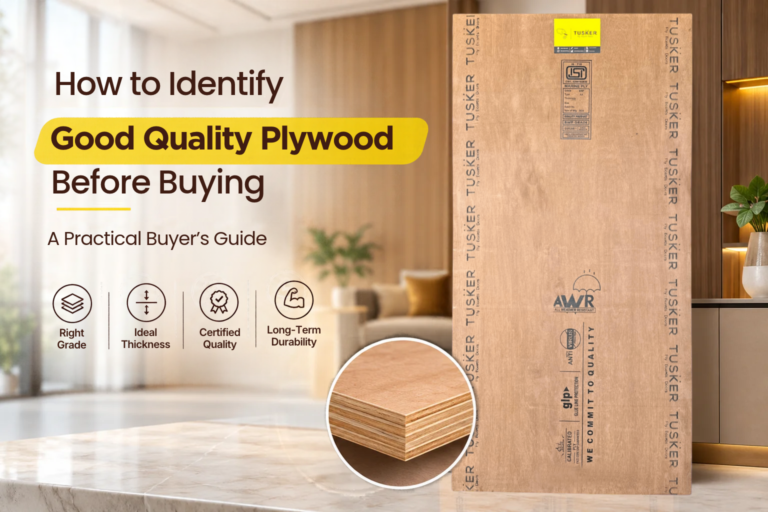
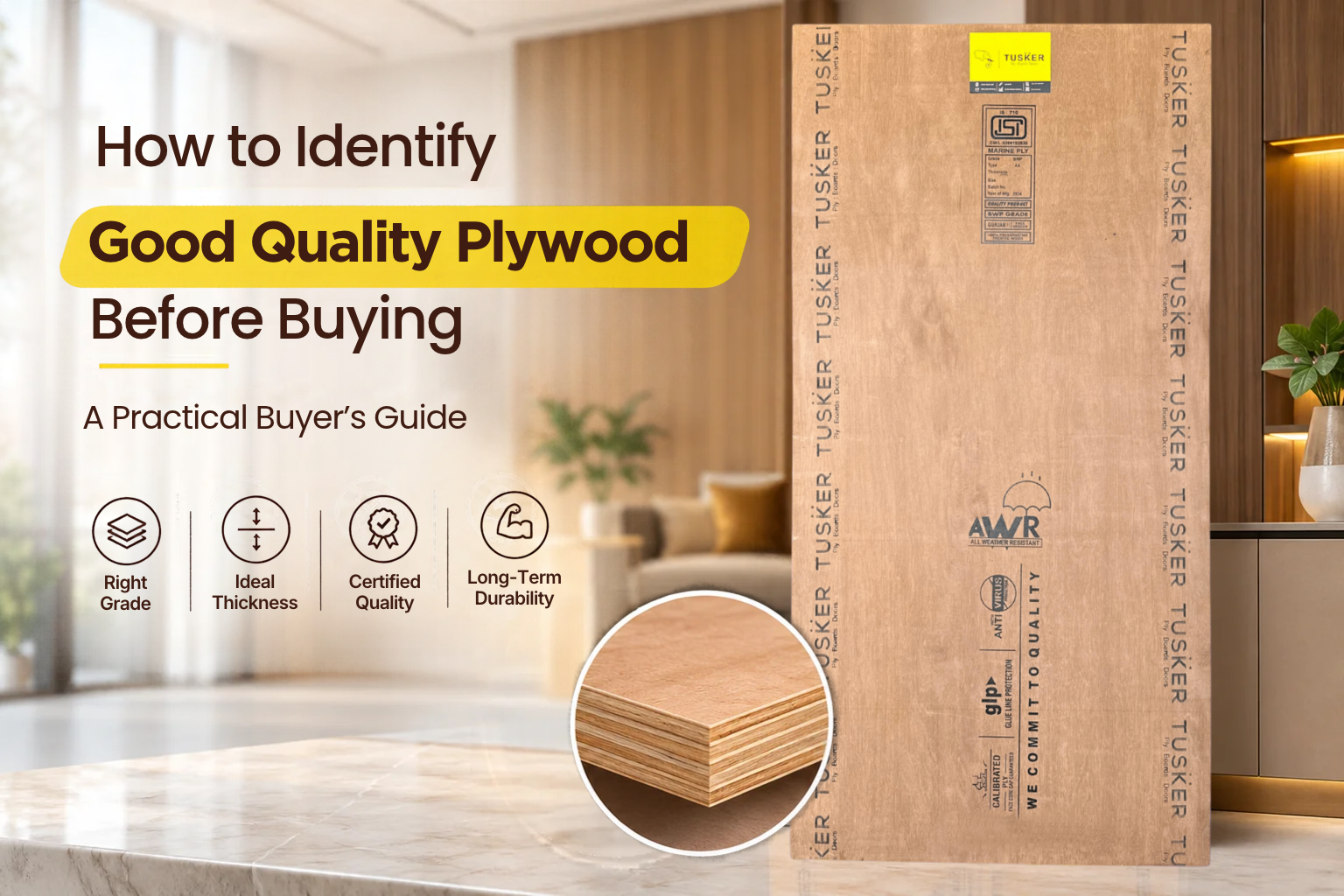
Look closely at the exposed edges of the plywood sheet. The internal layers should appear uniform, tightly bonded and free from significant visible gaps.
2. Check the surface finish
Good quality plywood should have an even surface without excessive roughness, bubbles, cracks or visible peeling.
3. Measure the thickness
Use a measuring instrument to check the thickness at multiple points. Consistent thickness helps achieve accurate furniture assembly.
4. Check for bending and warping
Place the plywood on a flat surface and inspect whether the sheet has excessive bends, twists or uneven corners.
5. Evaluate screw-holding strength
Ask the dealer to demonstrate screw holding on a sample piece. Reliable screw holding is important for hinges, drawers and furniture joints.
6. Inspect bonding quality
Check the edges for separating layers or signs of delamination. Weak bonding can reduce the structural integrity of the board.
7. Verify certification and product details
Look for applicable BIS certification, grade markings, manufacturer details and licence information. Ask for the product specifications and warranty terms.
Pro Tip: Request a cut sample before placing a bulk plywood order. Inspecting the cross-section can reveal problems that may not be visible on a full sheet.
4. Choose the Right Plywood Thickness for Your Furniture
Even the best quality plywood board may not perform as expected if the wrong thickness is selected.
For example, using a thin plywood sheet for a long bookshelf carrying heavy books may eventually cause sagging. Similarly, unnecessarily thick plywood can increase furniture weight and project costs.
Here is a practical plywood thickness selection guide:
| Furniture application | Suggested thickness |
|---|---|
| Cabinet back panels | 4–6 mm |
| Drawer bottoms | 6–9 mm |
| Decorative wall panels | 6–12 mm |
| TV units | 12–18 mm |
| Wardrobe shutters | 12–18 mm |
| Kitchen cabinets | 16–19 mm |
| Bookshelves | 18–25 mm |
| Study tables | 18–25 mm |
| Bed frames and structural furniture | 19–25 mm |
These are indicative recommendations. The final thickness should depend on furniture dimensions, support spacing, expected load and construction design.
Pro Tip: Discuss the intended furniture load with your carpenter before purchasing plywood. Choosing the correct thickness improves stability without unnecessarily increasing your budget.
5. Where Good Quality Plywood Makes a Real Difference
Premium-quality plywood provides a reliable foundation for various residential and commercial interior applications.
Modular kitchens
Improved cabinet stability and suitable moisture protection.
Bedroom wardrobes
Better support for shelves, shutters and hardware.
Living room furniture
Reliable construction with attractive finishing possibilities.
Office and study furniture
Strong workstations and well-supported storage systems.
Bathroom vanities
Better durability when appropriate plywood grades and sealing are used.
Commercial interiors
Functional furniture designed for frequent everyday use.
Real-world example: Consider two homeowners designing identical modular kitchens. One selects plywood based entirely on price, while the other checks its grade, bonding quality and thickness before purchasing. Over time, the second homeowner is more likely to experience fewer moisture-related issues and structural repairs, provided the furniture is properly installed and maintained.
Pro Tip: Think about how frequently your furniture will be used and what environmental conditions it will face before selecting plywood.
6. Good Quality Plywood Price vs. Long-Term Value
When comparing plywood prices, many buyers focus only on the initial cost per sheet.
However, the actual cost of furniture includes much more than plywood.
It also involves laminates, hardware, adhesives, carpenter charges, transportation, installation and potential future repairs.
| Low-quality plywood risks | Good quality plywood benefits |
|---|---|
| Premature bending | Better dimensional stability |
| Weak screw holding | More reliable furniture joints |
| Internal core gaps | Better structural consistency |
| Poor adhesive bonding | Reduced risk of delamination |
| Frequent repair requirements | Potentially lower maintenance costs |
| Shorter furniture lifespan | Improved long-term value |
Replacing damaged plywood often means replacing the laminate, hardware and other furniture components as well.
Therefore, the best quality plywood is not necessarily the cheapest or the most expensive option. It is the one that offers suitable performance, verified specifications and reliable quality for your intended application.
Pro Tip: Compare the overall lifetime cost of your furniture instead of comparing only the plywood price per square foot.
7. Common Mistakes to Avoid When Buying Plywood
Many furniture-related problems begin with avoidable purchasing mistakes.
- Choosing plywood entirely based on the lowest price.
- Using MR-grade plywood in areas with frequent water exposure.
- Ignoring internal core gaps and uneven veneer layers.
- Purchasing sheets without verifying grade and certification.
- Selecting incorrect plywood thickness.
- Assuming all plywood brands offer identical performance.
- Ignoring product warranty and its applicable conditions.
- Purchasing from an unreliable supplier.
- Assuming waterproof plywood does not require edge sealing.
- Approving bulk orders without inspecting sample sheets.
Avoiding these mistakes can help protect your investment and improve the overall performance of your interiors.
Pro Tip: Always request a proper purchase invoice mentioning the plywood brand, grade, thickness and quantity.
8. Why Consider Tuskerply for Your Interior Projects?
Beautiful interiors deserve a dependable foundation. At Tuskerply, we believe that furniture quality begins with selecting the right plywood for the right application.
Whether you are a homeowner planning a complete renovation, an interior designer creating premium spaces, a carpenter working on customised furniture or a dealer sourcing plywood, selecting the right material is essential.
When exploring Tuskerply products, evaluate the following characteristics according to the specific product range:
- Structural strength and durability
- Core veneer quality
- Surface finish
- Thickness consistency
- Moisture resistance
- Adhesive bonding quality
- Screw-holding performance
- Suitability for residential and commercial applications
From modern modular kitchens and elegant wardrobes to functional office furniture and sophisticated commercial interiors, the right Tuskerply product can form the foundation of a well-designed space.
Pro Tip: Consult your Tuskerply dealer for the appropriate product grade, technical specifications, certifications and warranty information before finalising your purchase.
9. Ultimate Plywood Buying Checklist
Use this simple checklist whenever you visit a plywood showroom.
Plywood quality checklist
0 of 11 checkedSelect the correct plywood gradeCheck the internal veneer layersInspect the surface finishMeasure thickness at multiple pointsCheck for bending and warpingEvaluate screw-holding strengthInspect adhesive bondingVerify applicable BIS certificationReview product warranty and specificationsPurchase from a reliable dealerCollect a proper purchase invoice
☐ Select the correct plywood grade
☐ Check the internal veneer layers
☐ Inspect the surface finish
☐ Measure thickness at multiple points
☐ Check for bending and warping
☐ Evaluate screw-holding strength
☐ Inspect adhesive bonding
☐ Verify applicable BIS certification
☐ Review product warranty and specifications
☐ Purchase from a reliable dealer
☐ Collect a proper purchase invoice