Imagine spending months designing your dream home. Your modular kitchen looks perfect, the wardrobes are beautifully finished, and every piece of furniture feels solid.
But termites don’t always attack where you can see them.
They can begin damaging plywood from hidden areas, and by the time visible signs appear, the damage may already have progressed. That’s why termite protection shouldn’t be considered only after furniture is installed. It should also be considered while selecting the plywood itself.
Traditional anti-termite treatment for wood is often associated with chemicals or treatments applied to exposed areas. Modern plywood technologies, however, can take a more integrated approach to protection.
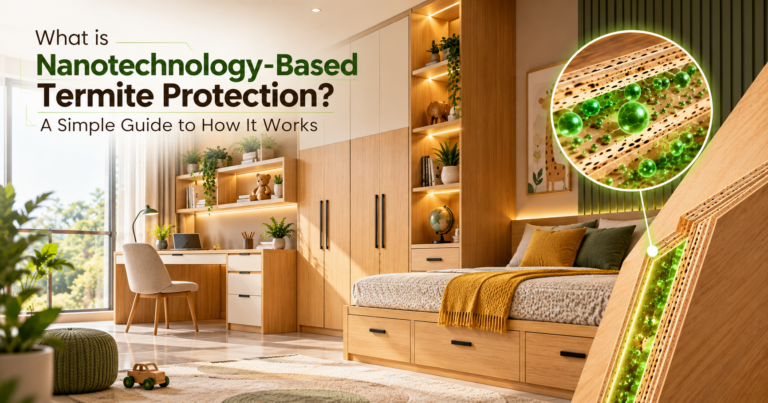
Let’s understand what nanotechnology-based termite protection means, how it can work in plywood, and what you should check before choosing termite-resistant plywood for your furniture.
What is Nanotechnology-Based Termite Protection?
Nanotechnology deals with materials and compounds at an extremely small scale.
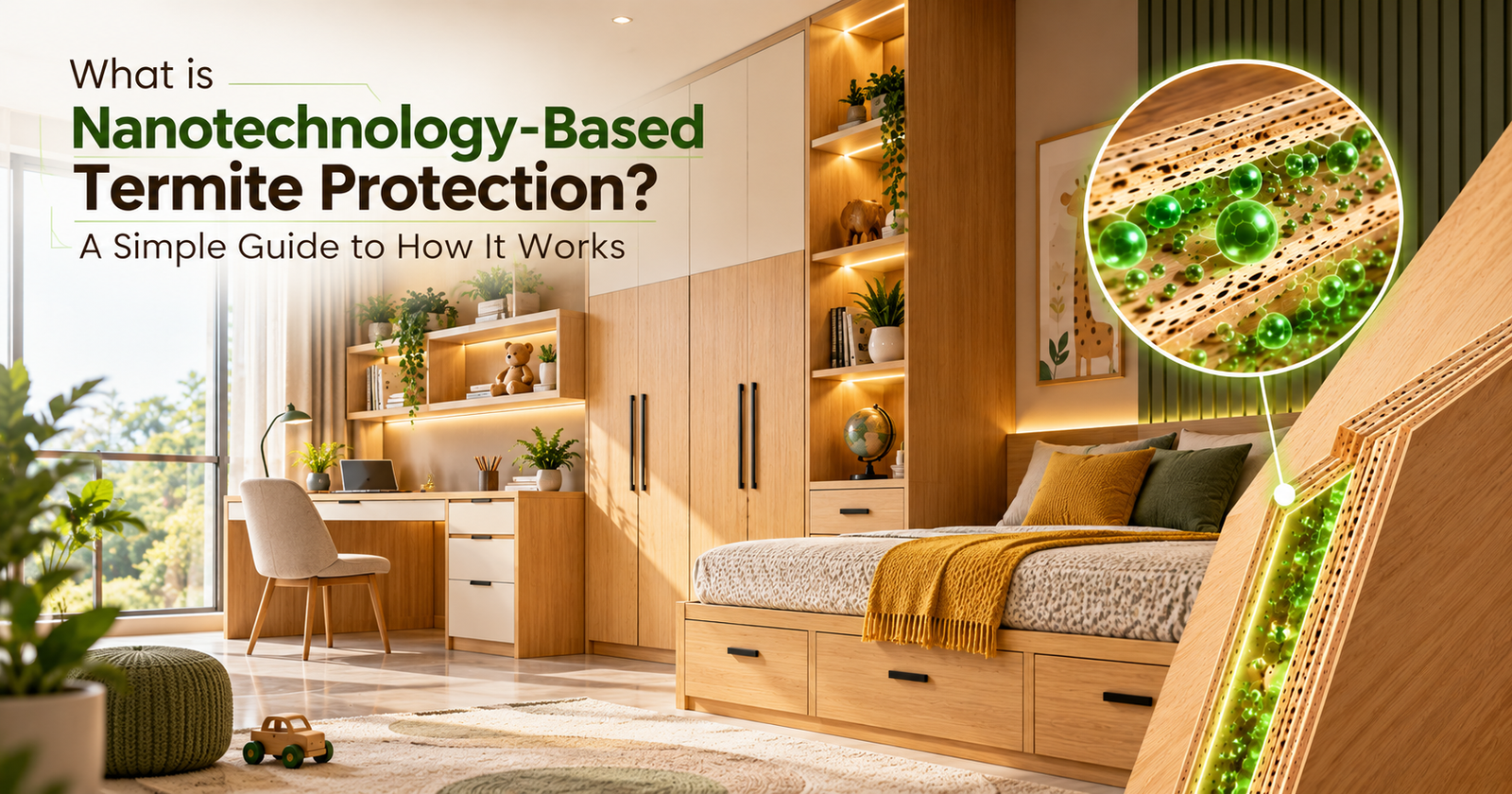
When such technology is used for plywood protection, the objective is to enable protective compounds to work beyond only the visible outer surface of the board.
Why does this matter?
Because the plywood sheet you purchase doesn’t remain in its original form.
During furniture manufacturing, a carpenter may:
- cut the plywood into different sizes,
- drill holes for hinges,
- install screws and fittings,
- trim the edges,
- create grooves,
- join different pieces, and
- shape the board according to the furniture design.
If protection exists primarily as an external layer, modifications to the plywood can affect that treated surface.
An integrated protection approach is designed to provide protection deeper within the plywood rather than relying solely on its exterior.
Pro Tip
When buying anti-termite plywood, don’t ask only:
“Is this plywood termite resistant?”
Also ask:
“How is the termite protection provided?”
Understanding the technology behind the claim can help you compare plywood more effectively.
How Does Integrated Termite Protection Work?
Think about a raincoat.
A raincoat protects you because there is a protective barrier on the outside. If that barrier is significantly damaged, its ability to protect you can be affected.
Surface treatments work on a broadly similar principle: protection is concentrated on treated areas.
Integrated protection takes a different approach.
The objective is to introduce the protective technology deeper into the plywood during manufacturing so that protection isn’t dependent only on the visible exterior.
This can be particularly relevant for furniture because plywood undergoes substantial fabrication before reaching its final form.
Real-World Example
Suppose a carpenter is making a wardrobe.
One large plywood sheet might be cut into:
- two side panels,
- multiple shelves,
- partitions,
- drawers,
- shutter components, and
- internal supports.
The carpenter then drills numerous holes for hinges, channels, screws, and other hardware.
This is why the technology behind termite-resistant plywood matters—not simply the appearance of the finished sheet.
Pro Tip
Before purchasing plywood for a major interior project, ask your dealer or manufacturer for technical information explaining the termite-protection process.
Why Does Deeper Protection Matter in Furniture?
Termites can be difficult to detect during the early stages of an infestation because much of their activity may occur in concealed areas.
Furniture contains plenty of such spaces.
Consider a modular kitchen. Once installation is complete, several plywood sections may remain hidden behind cabinets, below countertops, inside storage units, or against walls.
The same is true for:
- wardrobes,
- storage beds,
- TV units,
- wall cabinets,
- office furniture, and
- built-in storage.
If termites reach these concealed areas, homeowners may not immediately notice the problem.
Choosing suitable anti-termite plywood at the material-selection stage can therefore become an important preventive consideration.
Pro Tip
Pay as much attention to hidden plywood as visible plywood.
The decorative laminate may create the look of your furniture, but the plywood underneath contributes significantly to its structure and durability.
Surface Treatment vs Integrated Protection
When comparing termite-proof plywood options, understanding this difference can help.
Surface-Based Treatment
A conventional anti-termite chemical for wood may be applied to exposed areas to provide protection.
Its performance can depend on factors such as:
- application quality,
- coverage,
- cutting,
- drilling,
- wear, and
- environmental exposure.
Integrated Protection
Integrated technology aims to introduce termite protection deeper into the plywood during manufacturing.
Instead of focusing only on:
Protecting the surface
the objective becomes:
Protecting the plywood more comprehensively from within.
This can be particularly useful for plywood because furniture manufacturing involves extensive cutting, drilling, and fabrication.
Pro Tip
Don’t compare two plywood products only by price per sheet.
Compare their grade, construction, termite-protection technology, applicable standards, warranty, and suitability for your intended application.
Where Should Termite-Resistant Plywood Be Used?
Termite protection can be valuable across many areas of a home or commercial interior.
However, the plywood should always be selected according to both its application and environmental conditions.
1. Modular Kitchens
Kitchens are demanding environments because furniture can experience humidity, spills, plumbing issues, and regular cleaning.
Base cabinets and sink areas deserve particular attention.
When selecting plywood for kitchens, consider both termite resistance and appropriate moisture resistance.
Pro Tip: Don’t automatically use the same plywood specification for every kitchen component. Areas close to sinks and plumbing may have different requirements from overhead cabinets.
2. Wardrobes
A wardrobe is expected to last for years and contains several concealed plywood surfaces.
Termite-resistant plywood can therefore be an important consideration for:
- full-height wardrobes,
- walk-in wardrobes,
- drawers,
- shelves, and
- loft storage.
Pro Tip: Ask what plywood is being used for internal shelves and structural sections, not just what laminate will appear on the shutters.
3. Beds and Storage Furniture
Storage beds can contain large quantities of plywood in enclosed areas.
Once assembled, some sections can become difficult to inspect regularly.
Selecting suitable anti-termite plywood during construction can therefore be valuable for long-term furniture.
Pro Tip: For beds, don’t focus only on termite protection. Check plywood thickness and structural suitability for the expected load as well.
4. TV Units and Living-Room Furniture
TV units, display cabinets, wall-mounted furniture, and storage units can also use substantial quantities of plywood.
Here, the board needs to satisfy structural, durability, and interior-design requirements.
Pro Tip: For wall-mounted furniture, discuss load, plywood thickness, hardware quality, and installation method with your carpenter or interior designer.
5. Office and Commercial Interiors
Plywood is widely used in:
- workstations,
- cabinets,
- partitions,
- counters,
- storage systems, and
- institutional furniture.
For projects expected to remain installed for years, choosing appropriate termite-resistant material at the beginning can reduce dependence on corrective measures later.
Pro Tip: For larger commercial projects, prepare a plywood specification before procurement so the appropriate grade and thickness are used for each application.
Termite Resistant and Waterproof Are Not the Same Thing
This is one of the most important points for homeowners to understand.
Termite resistance and water resistance describe different properties.
A plywood product offering termite protection isn’t automatically suitable for every high-moisture application.
Similarly, moisture-resistant plywood should not automatically be assumed to provide a particular level of termite protection unless the manufacturer specifies it.
Real-World Scenario
Consider two cabinets:
Cabinet A: Bedroom wardrobe
Cabinet B: Kitchen sink cabinet
Both may require termite protection.
But Cabinet B also faces a significantly greater possibility of water and moisture exposure.
Therefore, selecting plywood should involve evaluating the complete application, not one individual feature.
Pro Tip
For every furniture application, evaluate at least three things:
Termite protection + moisture requirement + structural requirement.
What Should You Check Before Buying Termite-Resistant Plywood?
Finding the best termite-proof plywood isn’t simply about choosing the product with the biggest claim printed on its label.
Use these checks instead.
Protection Technology
Understand how the termite protection works and whether it is limited primarily to the surface or designed to work deeper within the plywood.
Pro Tip: Ask for technical literature explaining the technology rather than relying only on verbal claims.
Plywood Grade
Choose a grade appropriate for where the plywood will actually be installed.
A bedroom wardrobe and a moisture-prone kitchen area can have very different requirements.
Pro Tip: Create a room-by-room material list before ordering plywood for a full-home interior project.
Thickness
Different furniture components may require different plywood thicknesses.
Thickness can influence structural performance, stability, and the type of furniture construction possible.
Pro Tip: Let the furniture design and structural requirement determine thickness—not simply the lowest available price.
Testing and Standards
Check whether the plywood conforms to relevant standards and whether the performance claims have appropriate testing or documentation.
Pro Tip: Ask your dealer to show you the relevant certification or manufacturer documentation where applicable.
Warranty
A warranty can be valuable, but the details matter.
Check:
- coverage period,
- what is included,
- exclusions,
- registration requirements, and
- documentation required for a claim.
Pro Tip: Keep your invoice, warranty information, and product details safely after completing your furniture installation.
Don’t Forget Basic Termite Prevention
Even when using termite-resistant plywood, good home maintenance remains important.
Pay attention to:
- persistent dampness,
- leaking pipes,
- moisture around sink cabinets,
- cracks and vulnerable entry areas,
- unusual powder near furniture,
- small holes or weakened wooden areas, and
- signs of pest activity.
If you suspect an active termite infestation, consider having the property assessed by a qualified pest-control professional.
Pro Tip
Add furniture inspection to your periodic home-maintenance routine.
Check hidden areas under sinks, inside storage furniture, behind accessible cabinets, and around wall-to-floor junctions.
Choose Plywood by What’s Inside, Not Just What’s Outside
When buying plywood, it’s easy to focus on what you’ll eventually see—the laminate colour, furniture design, polish, or finish.
But long-lasting furniture also depends on what lies underneath.
That’s why understanding termite-protection technology can be valuable when selecting plywood for a new home, renovation, modular kitchen, wardrobe, bed, or commercial interior.
Nanotechnology-based and integrated protection approaches aim to move beyond conventional surface-level treatment by providing protection deeper within the plywood.
When choosing Tuskerply for your furniture project, evaluate the appropriate product based on its intended application, plywood grade, thickness, termite-protection features, relevant testing or standards, and warranty terms.
Because beautiful furniture shouldn’t only look good on the outside.
The plywood inside matters too.